
REVIEW · PIRAN TOURS
8-Day Private Mountain Bike Tour from Arnoldstein to Piran
Ride from the Alps to the sea. This private Slovenian mountain bike tour links high mountain trails, the emerald Soča River, wine country, Karst villages, and the Adriatic in one carefully planned week. I like the changing terrain and the fact that your luggage moves between overnight stops, so you can focus on riding instead of hauling bags. The main catch is simple: this is a serious cycling holiday, not a casual sightseeing ride.
I also like the cultural variety. In seven riding days, you cross between Austria, Slovenia, and Italy, pass World War I sites, pedal through vineyards, and finish along the old Parenzana railway route into Piran. The long distances, steep climbs, and non-refundable booking terms mean you should check your fitness, equipment, insurance, and dates carefully before paying.
In This Review
- Key points at a glance
- What this Trans Slovenia route really offers
- Day 1: Arnoldstein, Mt. Peč, and the descent to Kranjska Gora
- Day 2: Vršič Pass and the Soča Valley
- Day 3: Boka Waterfall, Mt. Stol, and Kobarid
- Day 4: Krn, mountain pasture, and the Tolmin gorges
- Day 5: Mt. Matajur, Cividale, and Goriška Brda
- Day 6: The long Karst stage to Lokev
- Day 7: Socerb Castle, the coast, and Piran
- Accommodation, meals, and the value of support
- Fitness, equipment, and practical planning
- Who should book this private cycling holiday?
- Should you book the Arnoldstein to Piran tour?
- FAQ
- How long is the Arnoldstein to Piran mountain bike tour?
- Where does the cycling route begin and end?
- Is this a private tour?
- What meals are included?
- Is baggage transfer provided?
- What fitness level is required?
Key points at a glance
- From Arnoldstein to Piran: Ride from Austria’s southern border through Slovenia and Italy before finishing on the Adriatic coast.
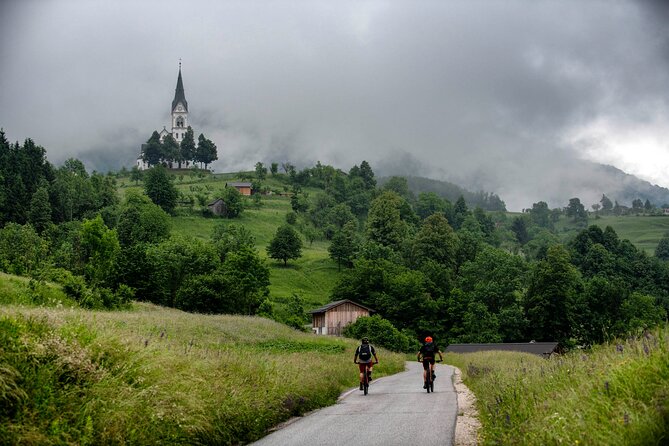
- A different ride every day: Expect alpine passes, single-track descents, river valleys, vineyards, Karst terrain, and coastal paths.
- Private format: Only your own group takes part, with a navigation pack and 24/7 support rather than a daily guide riding beside you.
- Luggage transfers included: Your bags are moved between the seven overnight stops, a major help on a point-to-point cycling trip.
- A demanding physical challenge: Daily distances range from about 23 to 87 kilometers, with substantial climbing on several stages.
- Extras can be arranged: Katia from Visit GoodPlace helped organize additions such as wine tasting and kayaking for one cycling group.
What this Trans Slovenia route really offers
This is a self-guided private tour with organized support. You receive GPS tracks, maps, a tour booklet, and a Skype call, then ride at your own group’s pace. A hotline operates around the clock, and baggage transfer removes one of the usual headaches of a multi-day bike tour.
The route covers seven nights in three or four-star hotels or guesthouses. Breakfast and dinner are included each day, while lunches, drinks, insurance, and personal cycling equipment are extra. That setup gives you structure without turning the trip into a large coach-style program.
The advertised price is $1,687.17 per person. For seven nights, seven dinners, seven breakfasts, route materials, baggage transport, support, and the return transfer from Piran to Arnoldstein, that can be fair value for a private cycling holiday. It is less attractive if you already have accommodation, transport, and route-planning covered.
The price also does not include bike hire, and the supplied details do not state that a bicycle is provided. Confirm this before booking. You should also ask exactly where the first-day pickup takes place, since the tour information lists Ljubljana as the location while the ride itself begins in Arnoldstein.
More Bike Tours in Ljubljana
- Ljubljana Bike Tour
★ 5.0 · 138 reviews - Ljubljana by E-Bike: Guided City Highlights Tour
★ 4.8 · 28 reviews - E-bike tour Škofja Loka
★ 5.0 · 27 reviews
Day 1: Arnoldstein, Mt. Peč, and the descent to Kranjska Gora
The opening stage begins in Arnoldstein, a small town near the Austrian border. The first climb takes you toward Mt. Peč and the Dreiländereck, the point where Austria, Italy, and Slovenia meet.
The climb is a useful test of your legs. The listed distance is about 23.4 to 25 kilometers, with 875 to 1,030 meters of climbing. That is not a gentle warm-up for someone who rarely rides hills, but it gives you an early sense of the week ahead.
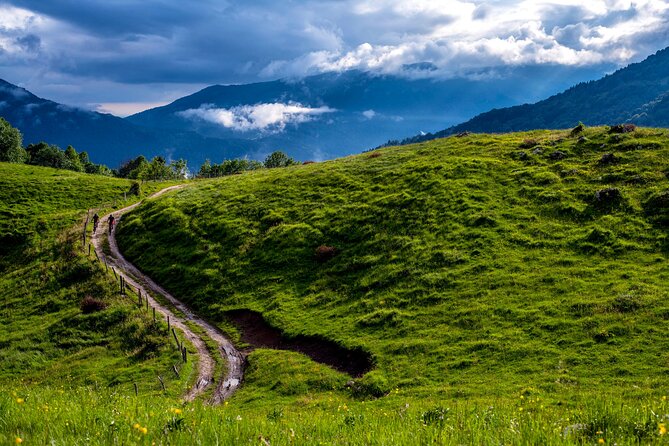
At the top, the reward is a broad view toward the Julian Alps, Gailtal Alps, the High and Low Tauern, and the Karavanke range. The descent to Kranjska Gora brings the first real thrill of the trip.
Kranjska Gora is a practical overnight base for the next stage. Keep your evening easy. Day 2 is much longer, and the initial ride may take more out of you than the distance suggests.
Day 2: Vršič Pass and the Soča Valley
From Kranjska Gora, the route passes Lake Jasna before tackling Vršič Pass. At 1,611 meters, Vršič is the highest road pass in Slovenia’s eastern Julian Alps and a major landmark for cyclists.
The stage covers about 52.2 kilometers and lists 1,205 meters of climbing. You should expect a sustained mountain day, with the pass providing the main test. The reward comes on the other side, where the route drops into the Trenta Valley inside Triglav National Park.
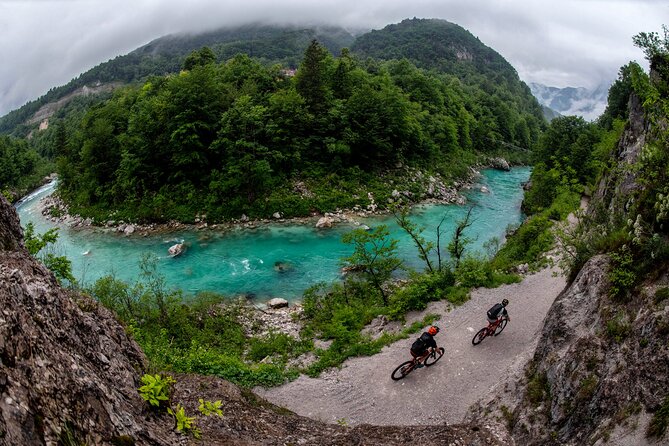
This is one of the most memorable sections of the trip. The Soča River runs through the valley in striking green-blue water, with the Julian Alps rising around it. The route follows the river toward Bovec, a well-known base for outdoor sports.
Bovec offers optional activities through local agencies, including rafting and kayaking. These are not included in the package, so treat them as possible additions rather than part of the cycling schedule. If you want to fit one in, ask Visit GoodPlace to help arrange it before the trip. Katia was specifically praised for organizing extra activities, including kayaking and wine tasting.
The drawback is timing. A mountain ride ending in Bovec may leave you tired, and adding another strenuous activity could be too much for some riders. Plan your energy rather than trying to collect every possible adventure.
Day 3: Boka Waterfall, Mt. Stol, and Kobarid
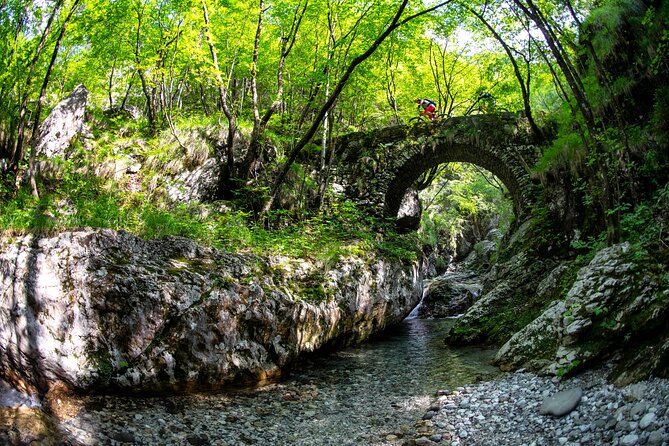
The third day begins near Boka, described as Slovenia’s mightiest waterfall. From the Žaga area, the route heads toward the Slovenia-Italy border and follows a former mule track toward Mt. Stol.
The distance varies widely, from about 23.6 to 46.9 kilometers, while the listed climbing ranges from 290 to 1,370 meters. That difference suggests route options or varying stage versions, so ask for the exact GPS track and daily plan before setting out.
Mt. Stol brings some of the finest views on the route. From the ridge, you can look across the Alps and the Soča Valley, and on a clear day you may see the sea. The ride then reaches a steep forest single track before finishing beside the Soča River.
The day ends in Kobarid, a lively base with strong World War I connections. The town is associated with the 1917 Battle of Caporetto, later described by Ernest Hemingway in A Farewell to Arms. That context gives the ride more weight than a simple succession of mountain views.
This stage should suit riders who enjoy rougher trails and changing surfaces. If you are uneasy on steep single track, ask how technical the descent is and make sure your bike and protective equipment are appropriate.
More Bike Tours in Piran
- Panoramic Piran and Salt Pans: E-Bike Boutique Tour
★ 5.0 · 25 reviews - Piran: Bike Rental with Map, Helmet, Water bottle and Lock
★ 4.7 · 23 reviews - Panoramic Piran and Salt Pans: E-Bike Boutique Tour
★ 5.0 · 7 reviews - Piran: e-bike&snack in Istria
★ 4.7 · 6 reviews
Day 4: Krn, mountain pasture, and the Tolmin gorges
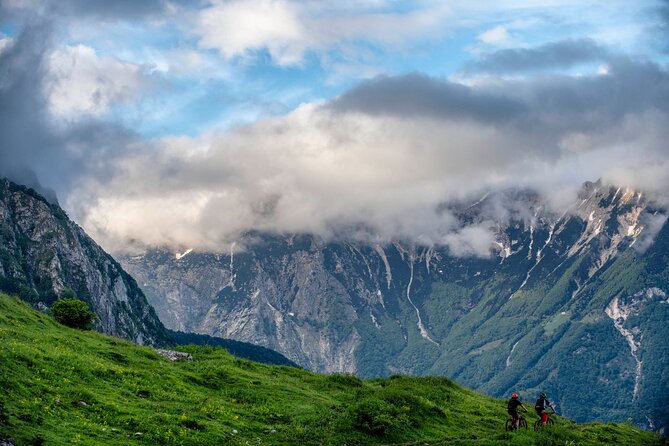
The ride from Kobarid to Tolmin is presented as the toughest section of the trip. You climb toward Krn village and then continue to the Pretovč mountain pasture.
The figures explain why: roughly 16.6 to 37.2 kilometers, with climbing listed from 140 to 1,390 meters. The short-distance option may still feel hard because of the ascent. Do not judge this stage by kilometers alone.
The effort pays off with a long downhill run toward the Tolminka River valley. Along the way, you pass the Memorial Church of the Holy Spirit, built as a First World War monument. It is a quiet reminder of how much conflict shaped these mountain valleys.
The Tolmin gorges provide another worthwhile stop. You can visit this popular natural site before continuing into Tolmin. Since the daily schedule is self-guided, you will need to balance sightseeing time against your riding pace.
I like this stage because it joins physical challenge with a real sense of place. The possible weakness is that the route may feel compressed if you want plenty of time for the church, gorge, and downhill ride.
Day 5: Mt. Matajur, Cividale, and Goriška Brda
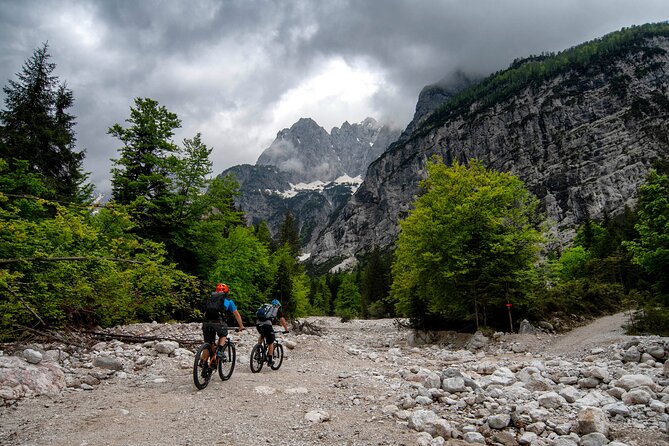
Day 5 changes the mood. The ride climbs Mt. Matajur, then gives you a long descent through the woods to Cividale del Friuli in Italy. The descent lasts about two hours according to the tour description, making it one of the week’s major riding highlights.
The listed distance ranges from 34.4 to 80.7 kilometers, and the climbing figure reaches as high as 2,440 meters. That is a substantial number. Confirm what the figure represents and which route version applies to your group.
Cividale provides a pleasant cultural break before the route enters the Collio wine area. The riding becomes easier as you pass vineyards and cross back into Slovenia toward Šmartno in Goriška Brda.
This region is known for rolling hills, orchards, vineyards, and small villages. It feels distinctly different from the high Julian Alps. Wine is central to the area, and a tasting is a sensible extra if your schedule allows it. The provider has arranged wine tastings for groups before, so ask about options during the planning call.
The key issue here is distance. The shortest and longest versions differ greatly. A route of 34 kilometers and one of 80 kilometers require very different levels of stamina, so do not rely on the headline itinerary alone.
Day 6: The long Karst stage to Lokev
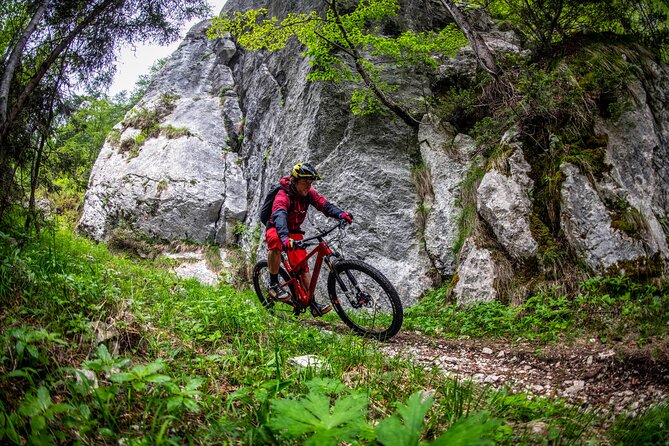
Day 6 is the longest riding day, with about 77.2 to 87.3 kilometers and 1,020 to 1,520 meters of climbing. This is where steady pacing matters most.
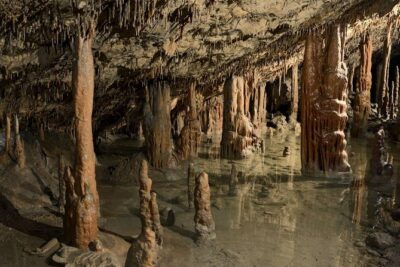
The route enters Slovenia’s Karst region, known for sinkholes, disappearing streams, and underground caves. More than 8,000 caves have been recorded in Slovenia, though only about 20 are open to the public. You may not have time for a cave visit during this stage, but the underground geology helps explain the unusual surface terrain.
You also pass through a wine-growing area associated with teran, a ruby-red wine. Small hilltop villages contain traditional stone houses, giving the ride a strong local character.
The stage ends near Lipica, home of the famous white Lipizzaner horses and a stud farm established there in 1580. The tour description does not say that a visit is included, so treat Lipica as a nearby point of interest rather than a guaranteed activity.
This is the day when baggage transfer matters most. You still need to carry only your riding essentials, while your larger bags go ahead to the next accommodation. Even so, nearly 90 kilometers after several demanding days will test your legs.
Day 7: Socerb Castle, the coast, and Piran
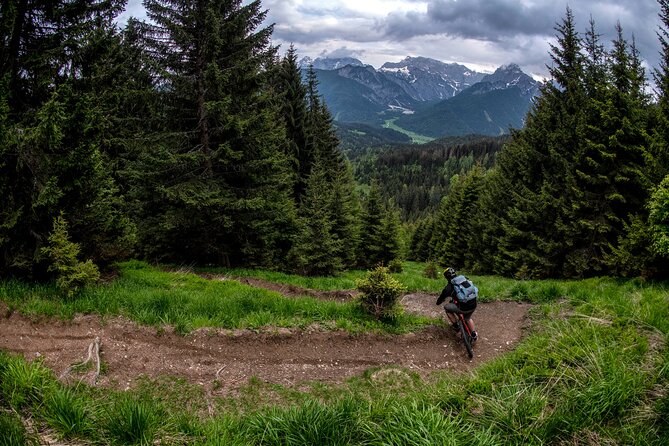
The final riding day covers about 62.8 to 66.2 kilometers, with 990 to 1,500 meters of climbing. You first ride toward Socerb Castle, which looks over the Gulf of Trieste.
From there, the route descends to Osp, one of Slovenia’s oldest villages, first recorded in 1067. The trail then heads toward sea level and the coastal city of Koper.
The finish uses part of the Parenzana, a former narrow-gauge railway that once connected Trieste with Poreč. Along this route, you pass through narrow tunnels before reaching Piran.
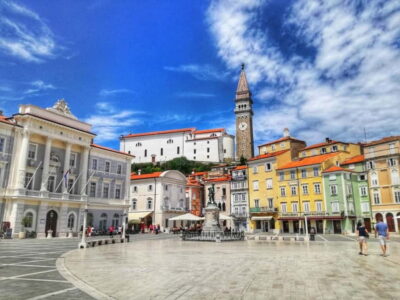
Piran is a fitting endpoint. Its old town has Venetian Gothic architecture and sits on the Adriatic, giving you a striking change from the mountain valleys of the first half of the week. After seven days of climbing and rougher trails, the arrival by bike should feel earned.
The final stage still has plenty of climbing before the descent to the coast. Do not assume the sea means an easy day. The mileage is moderate by comparison with Day 6, but accumulated fatigue is part of the calculation.
Accommodation, meals, and the value of support
Seven nights in three or four-star hotels and guesthouses are included. The exact properties are not specified, so you should ask about room arrangements, bicycle storage, and the locations of the overnight stops.
Breakfast and dinner are included for all seven nights. Lunches are not, and drinks at included meals also cost extra. Carrying food and water during each stage is your responsibility, so plan for the long days, especially Days 5 and 6.
The navigation pack is useful for independent riders. GPS tracks, maps, and a tour booklet give you several ways to follow the route, while the Skype call should help you understand the week before arrival. The 24/7 hotline adds reassurance if you have a route or logistical problem.
This is not the same as having a guide physically ride with you. You need to be comfortable following navigation and making basic decisions as a group. The private format is a major advantage if your party has a shared pace and wants flexibility, but it puts more responsibility on you than a fully guided tour.
Fitness, equipment, and practical planning
The tour requires a strong level of physical fitness. That warning is justified by the combination of mountain passes, long climbs, forest descents, single-track riding, and distances approaching 87 kilometers.
Bring or arrange suitable personal safety and cycling equipment. The package excludes those items, and the supplied details do not specify helmet, bike, repair kit, or protective gear. Confirm what you need before departure rather than assuming the provider supplies it.
Travel and activity insurance are also excluded. This matters because the trip crosses mountain terrain and includes optional activities such as kayaking or rafting. Arrange coverage that fits both cycling and any extra activities you add.
The start time is listed as 9:00 a.m., with pickup offered. The stated start point is Arnoldstein, while the location field lists Ljubljana. Confirm the exact meeting arrangement, especially if you are arriving independently or using public transportation.
The last morning is simple. After breakfast in Piran, a transfer takes you back to Arnoldstein, where the trip began. That return transfer is included and saves you from solving a cross-border transport problem after a week of riding.
Who should book this private cycling holiday?
I would recommend it to fit mountain bikers who want a point-to-point challenge and enjoy planning their own riding days. It suits a group of friends particularly well, since only your group participates and optional additions can be arranged around your interests.
It is also a strong choice if you want more than scenery. The route includes alpine border country, Triglav National Park, Soča Valley war sites, Italian and Slovenian wine areas, Karst geology, Lipica, and the Adriatic coast.
I would hesitate if you prefer gentle cycling, short daily rides, or a guide handling every turn. The route figures vary considerably, and several days require serious climbing. You also need to be comfortable with a non-refundable booking.
Should you book the Arnoldstein to Piran tour?
Book it if you want one demanding week that shows Slovenia from several angles, not just from a bus window. The combination of baggage transfers, private riding, GPS support, included dinners, and a return transfer gives the price real practical value.
Before committing, confirm the exact route distances, the Arnoldstein pickup details, bike arrangements, accommodation, and equipment requirements. If your group is fit, prepared, and happy to ride independently, this is an unusually varied way to cross Slovenia from the Julian Alps to the sea.
FAQ
How long is the Arnoldstein to Piran mountain bike tour?
The experience lasts eight days, including seven nights of accommodation and seven riding days. The final day includes breakfast in Piran and a transfer back to Arnoldstein.
Where does the cycling route begin and end?
The cycling route begins in Arnoldstein near Austria’s southern border and ends in Piran on Slovenia’s Adriatic coast. The tour information also lists Ljubljana as the location, so confirm the exact pickup arrangement before departure.
Is this a private tour?
Yes. Only your group participates. The tour includes GPS tracks, maps, a booklet, a Skype call, and a 24/7 hotline rather than a guide riding with a larger group.
What meals are included?
Seven breakfasts and seven dinners are included. Lunches and drinks consumed with included meals are not included.
Is baggage transfer provided?
Yes. Your baggage is transferred between the tour stages during the seven-night trip.
What fitness level is required?
A strong physical fitness level is required. Daily distances range from about 23 to 87 kilometers, and the route includes major climbs such as Vršič Pass, Mt. Stol, Krn, Mt. Matajur, and the Karst stages.
Just added in Ljubljana
- Zagreb to Slovenia: Discover Bled and Ljubljana in a Day★ 4.7 · 2 reviews
- Gokart experience at Woop! karting – the fastest attraction★ 4.0 · 5 reviews
- Woop! Fun park with 21 attractions★ 4.6 · 3 reviews
- 1 Hour Private Woop Challenges in Jurčkova Cesta★ 5.0 · 2 reviews
- Private Zagreb Tour from Ljubljana★ 4.5 · 3 reviews
- Wine and Culinary Adventure in Jeruzalem – Full Day Tour from Ljubljana or Ptuj★ 5.0 · 5 reviews
- Half-Day Small-Group Hiking Tour of Viševnik★ 5.0 · 2 reviews
- UNESCO’s Skocjan Caves, Europe’s largest underground canyon, Half Day Trip from Ljubljana★ 5.0 · 6 reviews
Piran Tours, compared.
Piran Walking Tour with Local Wine and Food Tasting
Read our review →
UNESCO-Listed Škocjan Caves and Piran Day Trip
Read our review →
Skocjan UNESCO Caves and Piran full day tour (small group, max. 8)
Read our review →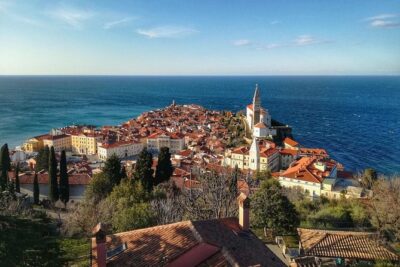
Postojna cave, Predjama castle and Piran tour from Ljubljana
Read our review →Browse the lists this tour appears in